What a major project in Sweden taught me about 8-hour shifts, common sense culture, FIFO trade-offs, and the rewards of slowing down and tuning in.
“Volvo, Villa, Vovve.”
It’s a phrase that always comes to mind when I think back to working on a large-scale petrochemical cracker project on the West Coast of Sweden.
A client manager — and friend — explained it to me one bright summer day over lunch in Stenungsund, just north of Gothenburg.
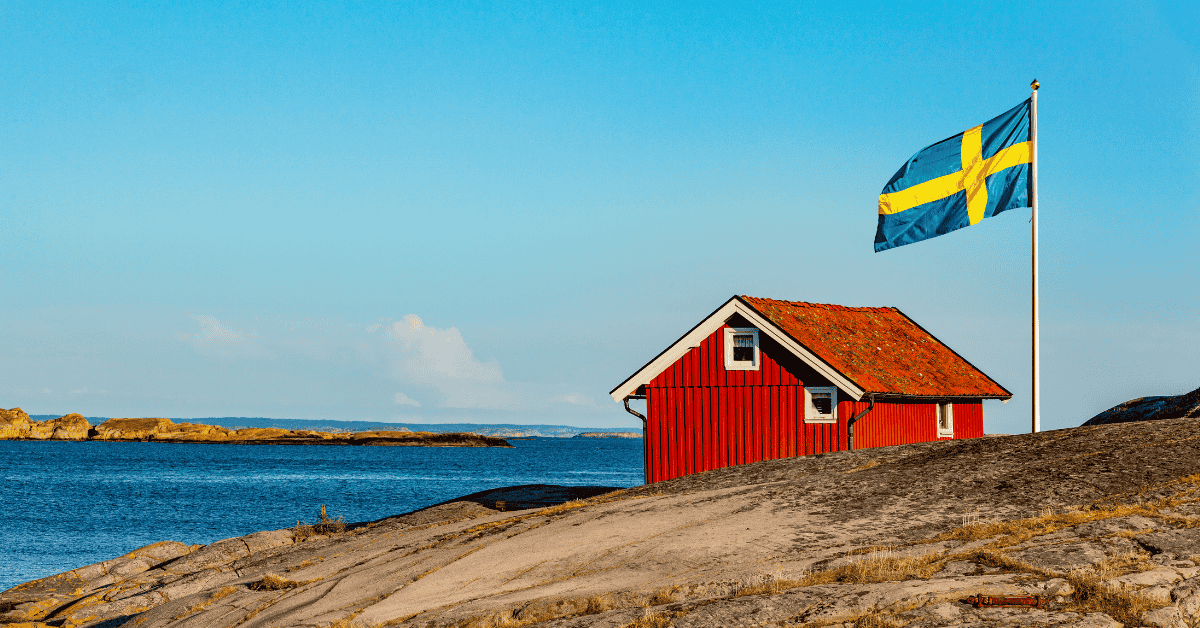
Volvo, Villa, Vovve — or in plain English: Car, House, Dog.
At first, it felt like a throwaway line. But over time, I came to appreciate the depth behind that seemingly simple expression — especially among middle-class workers in Sweden.
It represents a kind of balance and simplicity you rarely find elsewhere.
Not the endless grind or the scramble for share portfolios, side hustles, or 14-hour shifts.
Just the fundamentals: A roof over your head. A dog to greet you. A safe, reliable car to get you around.
But if you’re coming to Sweden looking for late nights living it up —
be warned: you might have to sell your house, your dog, and your Volvo just to afford a night out.
Working Hours in Sweden: Common Sense Over Overtime
I’ll never forget the look on the local ops team’s faces when some of the contractors started pushing for extended hours and as much overtime as they could get signed off. You could feel the shift in energy.
They didn’t argue, didn’t push back — they just stared at us like we’d grown two heads. You could almost hear the thought forming: “Why on Earth would you do that for?” And they weren’t being sarcastic. They were genuinely baffled.
Because in Sweden, the 8-hour eight-hour day still holds strong.
It’s not about ticking boxes or chasing productivity for productivity’s sake — it’s just how things are done. You show up, you do your job properly, and you go home. Not because you’re lazy or lack ambition — far from it. But because life outside of work matters just as much as what happens on site.
It’s a common-sense culture built on trust, balance, and doing things well without burning people out.
Of course on Large International Projects or Turnarounds exceptions may be made, but these are exceptions and not necessarily the norm.
So if you’re tendering for work in this part of the world, don’t build your programme around 12-hour shifts and weekend push. That may not fly here.
The idea of throwing long hours at a problem to ‘accelerate’ the schedule will raise more eyebrows than support.
And to be honest, once you settle into it… it starts to make a lot of sense.

HSE and Culture: People Before Process
One of the most fascinating aspects of working internationally in HSE is seeing how cultural norms directly shape project outcomes and behaviour
I’ve worked with all sorts of crews — the larakin Irish, the laid-back ‘have-a-crack’ Aussies, the hard-working Eastern Europeans who tackle a work front in numbers and just get stuck in, the practical Dutch, the regulation-driven Brits, and the quietly flexible Belgians, to name but a few.
And then there are the Swedes — masters of what I can only describe as “common sense culture.”
It was particularly apparent during one investigation into a Life Saving Rules violation.
As we tried to dig into root causes, we kept hitting a wall — the same puzzled question from Swedish colleagues:
“But… why on earth would you do that for?”
It wasn’t judgment — just genuine confusion. A kind of quiet disbelief. Eventually, we got there, but that simple question said a lot on its own.
Sweden – A Land of Projects (With Its Own Pace)
While the Swedes may not be rushing to work overtime, there’s no shortage of big, bold projects quietly unfolding across the country.
From petrochemicals to renewables and now data centres, Sweden is positioning itself as a key player in the next generation of European infrastructure — just on its own terms.
- The petrochemical sector is evolving, with a strong shift toward decarbonisation, carbon capture, and bio-based processes.
- Renewable energy continues to expand, particularly wind power, with growing focus on grid integration, energy storage, and sustainable build-out.
- Data centres are booming — driven by cloud demand, AI, and Sweden’s attractive mix of renewable power, cool climate, and stable infrastructure.
But again, sustainability is baked into every part of the conversation — from power PPAs to circular cooling systems.
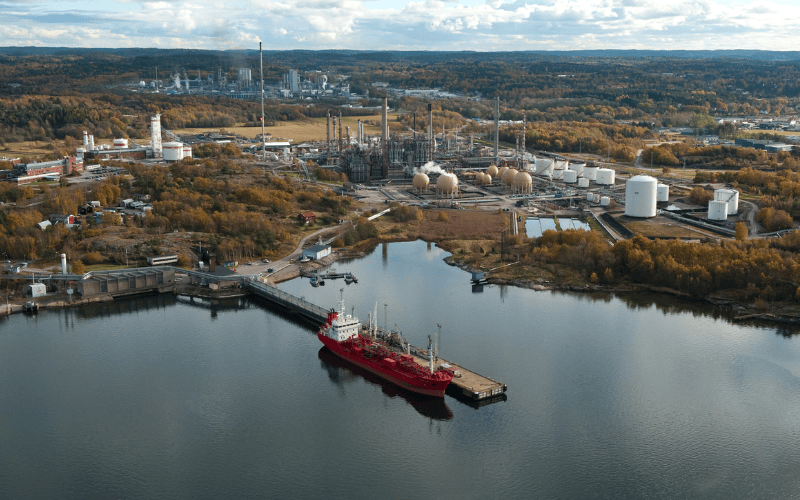
Image credit: Borealis Group, used for editorial purposes.
A Landscape and a Lifestyle That Stays With You
Above all, it was Sweden’s vast wilderness that truly captivated me.
I remember staring out the plane window as we began our descent into Gothenburg — an endless horizon of dense forest stretching in every direction. It was wild, untouched, and quiet in a way I hadn’t expected. Over 70% of Sweden’s landmass is covered in forest, and less than 2% is densely populated. Add to that more than 260,000 islands, and you begin to get a sense of how truly vast and natural this place still is.
On one particularly long run deep in the forest, I remember thinking it was one of the few places in Western Europe where I genuinely did not want to lose my way. If your phone battery dies out there, you could be in for a long, cold night. But that was part of the appeal too — the rawness of it.
During downtime — after work or on weekend stays — I found myself exploring the forests, coastlines, and rugged terrain that surrounded our project base. Trail running, coastal kayaking, and open water swimming became part of the rhythm. Not things I’d planned. But the kind of things you do when the wilderness is calling just outside your door.
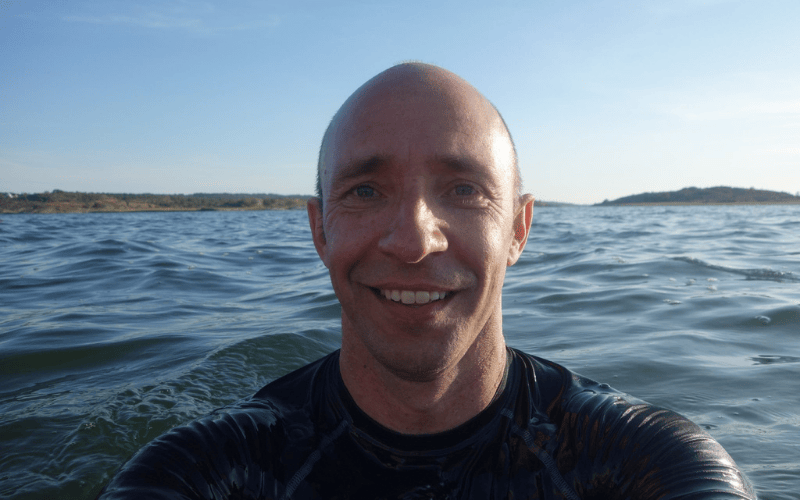
One summer evening, while swimming in one of the local inlets, I watched local families splashing around together — chatting in the lyrical rhythm of the Swedish language. There was something quietly profound about it. A sense of calm. Of belonging. It made me reflect on how finding time for simple daily rituals like this is what really matters in the long run.
It also brought a twinge of something more personal — the kind of ache that comes when you’re far from home. I thought of my own family. And of the sacrifices so many FIFO (fly-in, fly-out) workers make just to keep food on the table. It’s something we don’t always talk about in our industry, but it’s always there in the background.
And then there were the evenings. Watching the sun go down over the West Coast archipelago, the stillness of the North Sea, and the clusters of islands scattered out to the horizon… it’s not something I’ll forget in a hurry.
Final Thought: Perspective Over Productivity
What I’ve come to realise is that understanding the local culture — how people live, think, and work — isn’t just a ‘nice to have’. It’s what makes the difference between a project that survives… and one that actually succeeds.
But it goes deeper than that.
Working in a place becomes so much more rewarding when you actually spend time in it. Not just on-site, but in it — immersed in its rhythms, its landscapes, its language, its way of life. When you stop trying to force your own tempo onto everything and instead learn the local one, everything starts to shift — including how you see your own role.
Sweden was more than just a job. It was a reminder of what balance can look like — on site and off. A place where common sense carries more weight than bravado, where an eight-hour shift means eight hours, and where families still take time for the sea, the sunset, and each other.
And it made me reflect on my own choices — the FIFO days, the time away, the trade-offs we make in this line of work. Sometimes we’re so focused on delivering outcomes that we forget the people behind them — including ourselves.
That’s the kind of thinking I try to bring to every project now — not just safe systems, but sane ones; not just productivity, but perspective.